

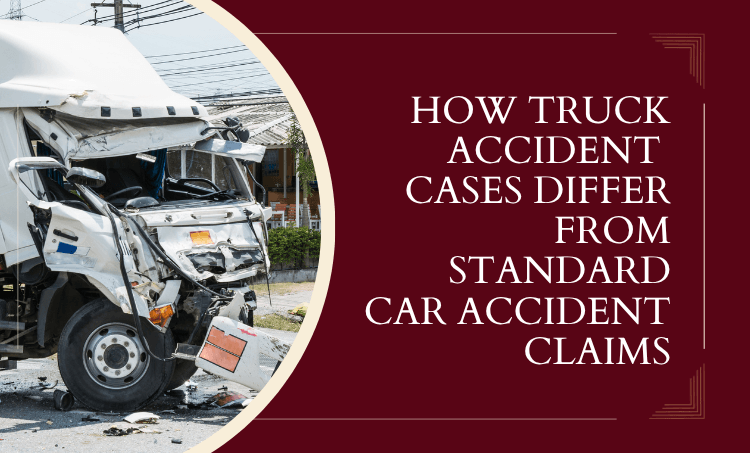
A truck accident claim vs car accident claim is not handled the same way under the law. While both involve motor vehicle crashes, truck accident cases are often more complex, more aggressively defended, and potentially more valuable.
If you were injured in a crash involving a semi-truck or commercial vehicle in West Virginia, Ohio, or Pennsylvania, it is important to understand how these cases differ from standard car accident claims.
At Gold, Khourey & Turak, we regularly evaluate serious commercial vehicle collisions across the Ohio Valley and help injured individuals understand what makes these cases unique.
Truck Accident vs Car Accident: The Severity of Injuries
One of the biggest differences in a truck accident vs car accident case is the size and weight of the vehicles involved.
Commercial trucks can weigh up to 80,000 pounds when fully loaded. In contrast, a typical passenger vehicle weighs around 3,000 to 4,000 pounds.
Because of that size difference, truck accidents often result in more serious injuries such as:
• Traumatic brain injuries
• Spinal cord injuries
• Multiple fractures
• Internal bleeding
• Fatal injuries
Serious injuries generally increase the complexity and potential settlement value of a claim.
Multiple Parties May Be Liable
In a standard car accident, liability usually rests with one or more drivers.
In a truck accident vs car accident case, multiple parties may share responsibility, including:
• The truck driver
• The trucking company
• A maintenance provider
• A cargo loading company
• The truck manufacturer
For example, if a truck’s brakes fail due to improper maintenance, the maintenance contractor may be liable. If the driver exceeded federal driving time limits, the trucking company may also share responsibility.
Identifying all responsible parties requires investigation beyond the police report.
Federal Regulations Apply to Truck Accidents
Truck drivers and trucking companies are subject to federal regulations enforced by the Federal Motor Carrier Safety Administration (FMCSA).
These regulations govern:
• Hours of service limits
• Driver qualification standards
• Vehicle inspection requirements
• Maintenance schedules
• Drug and alcohol testing
Violations of these rules can significantly impact liability in a truck accident claim.
Passenger vehicle drivers are not subject to these same federal safety regulations.
Commercial Insurance Policies Are Larger
Trucking companies typically carry higher insurance policy limits than private drivers.
While a standard car insurance policy may carry minimum coverage limits, commercial trucking policies often provide:
• $750,000 to $1 million in liability coverage
• Higher limits for hazardous materials transport
Because larger insurance policies are involved, trucking companies and insurers often defend these cases aggressively.
Evidence Is More Complex in Truck Accident Cases
A truck accident vs car accident investigation often involves additional evidence, such as:
• Electronic logging device data
• Black box or event data recorder information
• Driver qualification files
• Maintenance and inspection records
• Dispatch and communication logs
This evidence may disappear quickly if not preserved. For that reason, prompt legal representation is often necessary to send preservation letters and protect critical data.
Corporate Defense Teams Respond Quickly
Trucking companies often deploy investigators immediately after a crash.
These teams may:
• Interview witnesses
• Inspect vehicles
• Collect driver statements
• Preserve or control company records
Their goal is to protect the company from liability exposure.
As a result, truck accident claims often require more immediate legal involvement to level the playing field.
Comparative Negligence Still Applies
West Virginia, Ohio, and Pennsylvania follow modified comparative negligence rules.
If you are partially at fault, your compensation may be reduced by your percentage of fault. If you are found more than 50 percent responsible, you may be barred from recovery.
Trucking companies sometimes attempt to shift blame to injured drivers to limit exposure.
Careful accident reconstruction and evidence review help address those arguments.
For general commercial vehicle crash data and safety reporting, the National Highway Traffic Safety Administration provides nationwide statistics.
You may also review our truck accident resources to better understand how commercial vehicle claims are handled in Ohio, West Virginia, and Pennsylvania.
Understanding Truck Accident vs Car Accident Claims
A truck accident vs car accident case involves additional layers of liability, federal regulations, higher insurance limits, and complex evidence.
Because of the size of the vehicles and the corporate entities involved, these cases require more detailed investigation and preparation than standard auto accidents.
If you were seriously injured in a truck crash, understanding these differences can help you protect your rights and evaluate your options.
Talk to a Truck Accident Attorney
If you were injured in a commercial vehicle crash in West Virginia, Ohio, or Pennsylvania, speaking with an experienced attorney at GKT can help you understand how a truck accident vs car accident claim may apply to your situation.
The team at Gold, Khourey & Turak is available 24/7 to review your case and explain your legal options.
Call (304) 845-9750, start a Live Chat, or complete our online form to schedule a free consultation.
Need help? Get help. Get GKT.

Michelle Marinacci is a partner at Gold, Khourey & Turak and a leading trial attorney in the areas of insurance bad faith, medical malpractice, and personal injury law.
With more than 25 years of experience, Michelle represents individuals and families who have been seriously injured in accidents or unfairly treated by insurance companies that refuse to honor their obligations.